Case studies / Mare Blu
Mare Blu Tuna Farm Ltd · Aquaculture — Malta
From paper and disconnected spreadsheets to seven integrated production systems
Before, every record was written on paper and typed again into a spreadsheet, and reports depended on a daily manual process. Now each record is entered once, where it happens, and seven integrated systems deliver reports to management and the authorities immediately.
Headline figures
- Basis
- Web, desktop and Android
- Basis
- Shipment, port arrival, discharge, warehouse, consumption and empty return — with container waiting and refrigeration costs at port, storage and inland haulage
- Basis
- Fourteen hours to two hours, through workflow redesign and automation
- Basis
- Own estimate, at market rates, of procuring the delivered scope externally
- Frame
- Avoided replacement cost, not a cash saving.
The starting point
Mare Blu farms bluefin tuna in cages off the coast of Malta. The company’s inventory is underwater and cannot be counted directly: the only measure of how many fish there are and what they have cost is the record of what enters the cages, what is transferred, what is harvested and what is fed. These are the same records the authorities require.
When I arrived in 2023, every record was kept on paper or sat in a separate file. The captains noted feeding at sea; harvest forms and sales notes were written aboard the factory ship, where the tuna are processed before frozen storage in its holds; the shore base recorded the discharge and preparation of the bait containers — the fish the tuna are fed. All of these paper reports were photographed and sent over WhatsApp to the office, which typed them in again. Catch documents, transfers between vessels and stock statistics sat in separate, unconnected files.
The information was accurate and it squared. The problem was the process: everything was typed in twice, consolidation was done by hand in spreadsheets, and the Director’s and the authorities’ reports depended on one person’s working day.
That person was me, for two years. I updated the spreadsheets daily, ran the transformation flows in EasyMorph and produced the reports for management and the authorities. The data model of the current systems, and the knowledge of the operation and its regulations, come from that period.
Diagnosis
Automating the spreadsheets would have accelerated the wrong process: everything would still be entered twice, just in a different format.
The right unit was not the report but the operational event: a feeding, fish entering a cage, a harvest, a container unloaded. Each event is at once a record for the authorities, a stock movement and a cost. The design captures it once, with author and time, and generates all three from that single record.
Records are not deleted: they are voided or reversed, and the correction is itself recorded with author and date. That makes the system defensible to an auditor.
Mandate and scope
- Contractual roleAdministration Officer. The systems work was delivered as functional scope, not as a separate job title.
- OwnedOperating model and functional architecture; business rules; data models and structures; reporting formats; platform choices; the permissions and access model; QA and validation criteria; the direction of debugging and correction; deployment, training, support and production acceptance. The operational and regulatory knowledge the systems encode is mine.
- AI assistanceClaude was used to accelerate code implementation, evaluate technical alternatives, refactor, debug, run verification checks and draft technical documentation. It did not define what the systems do or decide whether they were fit for production.
- Not ownedCommercial decisions of the farm, and the fishing and husbandry operations themselves.
The operating model
Implementation
Systems in production
- Feeding App v3Daily feeding operations and consumption against stock.
- Captain AppCapture at sea; keeps working without signal and syncs later.
- Supervisor AppSeven read-only live views across both databases.
- Caging AppCaging, transfers, releases and harvesting, with authority reporting.
- Bait ControlContainer logistics, unloading, consumption, FIFO costing and landed cost.
- Controlled StockRestricted-access register for regulated items, with full movement history.
- Reports ViewerWeb reporting portal — 39 reports across five access roles.
Before
- Events written on paper at sea and ashore, typed again in the office
- Disconnected digital sources; consolidation spreadsheets kept by hand
- Bait arrival, consumption and cost tracked in three separate places
- Paper records with no machine-readable author or time
- Supplier payment processing: fourteen hours
After
- Capture on tablets, at sea and ashore — one record, at source, syncing later if the signal drops
- Applications in four languages — Spanish, English, Italian and Arabic — because the crew is of several nationalities
- Seven systems, in daily use by 22 people
- Container tracked end to end, with FIFO costing and landed cost in the same record
- Void and reverse instead of delete; author and time retained on every event
- Supplier payment processing: two hours
Before writing code, I documented every procedure and business rule in a knowledge repository — Obsidian connected to AI — accessible to the whole company. The goal was for operating knowledge to stop depending on a single person.
The systems were deployed onto the working farm, with no pilot. There were three constraints: tolerate signal loss at sea — capture keeps working offline and syncs later —, be faster than paper, and be usable by people whose job is fish, not software.
The biggest risk was that people who had always worked on paper would reject the change. Instead of imposing it, I started with the farm supervisor: I showed him the visibility the tool gave him over his own operation. His adoption pulled in the rest.
I defined the five access roles around how the operation actually runs, and did the training, support and production acceptance myself. Today 22 people use the systems daily, and other teams have started digitalising their own operations on their own initiative.
The screens
Two capture screens and two outputs, in the layout used in production. Every value is invented.
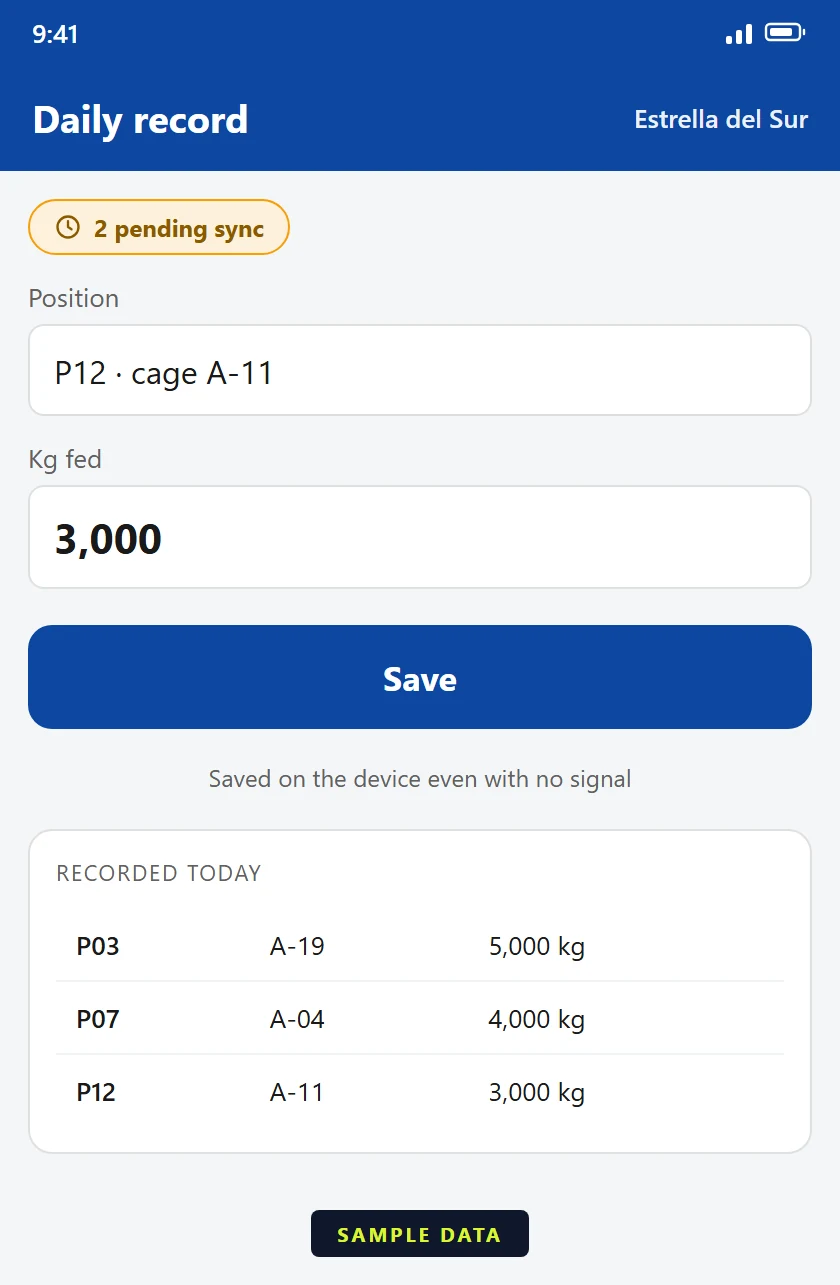
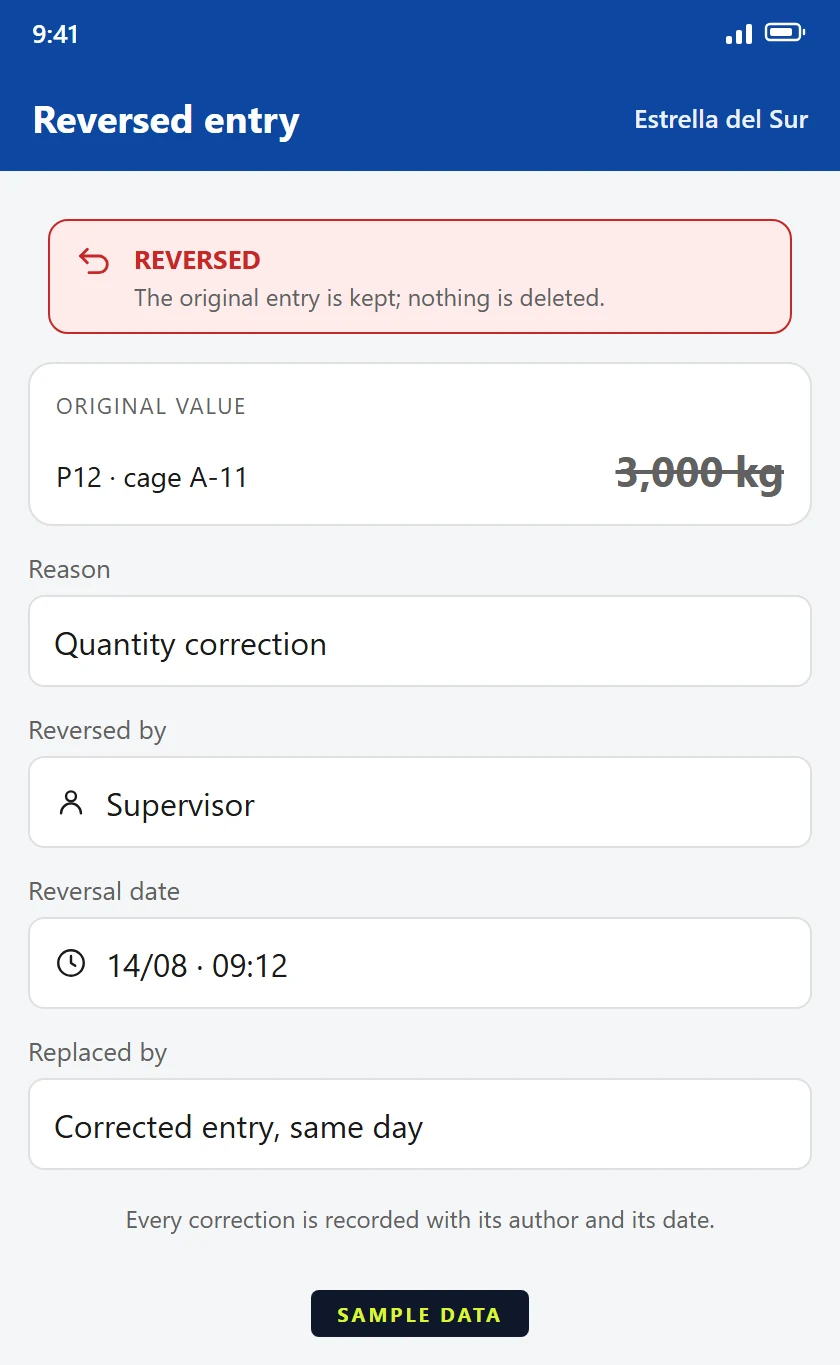


Reconstructions, not screenshots. The layout is the one in production; all data is fictitious.
Results
| Measure | Before | After | Basis of measurement | Result |
|---|---|---|---|---|
| Operational record | Paper and isolated spreadsheets | One operational and regulatory source | Seven systems in daily production use | 7 |
| Supplier payment processing | 14 hours | 2 hours | Workflow redesign and automation | −85% |
| Reporting | Compiled on request | 39 standing web reports | Web reporting portal, across five access roles | 39 |
| Capture at sea | Paper, re-keyed on shore | Digital entry at source, synchronised later | Three Android applications | 3 |
| Bait supply chain | Three disconnected records | End-to-end, with landed cost | Shipment, port, discharge, warehouse, consumption and empty return; container waiting and refrigeration costs at port, storage and inland haulage | 500+/yr |
| Record integrity | Paper and spreadsheets, editable by nature | Void or reverse only | Author and date retained on every operational event | — |
| External replacement | Procurement path | Built in-house | Own estimate, at market rates, of procuring the delivered scope — avoided replacement cost, not a cash saving | €200–500K |
What I carry forward
- Capture the event once, where it happens. The regulatory, stock, cost and management outputs all come from the same record.
- A record that can be deleted is not evidence. Void and reverse instead, with author and date on every correction.
- Design for signal loss, not for a perfect network. Capture keeps working offline and syncs on reconnection; the operation never waits for the network.
- Adoption is the deliverable. A system is worth as much as it is used: today that is 22 people every day.
Scope and measurement note
Figures reflect systems in production use at Mare Blu Tuna Farm Ltd as at the date of writing. The €200,000–€500,000 range is my own estimate, at market rates, of the cost of procuring the delivered scope externally; it is an avoided replacement cost, not a cash saving.
The functional architecture, business rules, data models, reporting formats, platform choices, QA, deployment, training and production acceptance were my responsibility. Claude was used to accelerate code implementation, evaluate technical alternatives, refactor and debug.
Omitted by design: supplier identities, commercial terms, procurement values, quota and regulatory case detail, and the parameters of the security configuration, which are described by their existence and not by their values.
Ferrovial (Broadspectrum) — Mining services — Chile
Looking for this kind of work in your operation?
Get in touch →